


The Different Faces of Success & Stress in The Devil Wears Prada


Three women. Three nervous systems.
Three completely different ways of carrying pressure.
A five-part series exploring the psychology of modern ambition and pressure.
PART THREE:
Miranda — The Weight of Being The Visionary
There is a reason Miranda Priestly walks into a room and everybody shifts.
Not because she is loud.
Not because she demands attention.
But because her presence carries weight.
Precision.
Authority.
Standards.
Expectation.
Miranda does not chase energy.
She directs it.
And honestly? I think that’s why she remains one of the most fascinating female characters in modern film culture.
Because underneath the couture, sharp one-liners, impossible standards, and iconic face expressions is something much deeper:
A woman carrying the immense weight of vision.
And that weight is heavy.
The older I get, the less interested I become in surface-level conversations about Miranda being “mean.”
That interpretation feels lazy to me now.
Because Miranda is not simply difficult.
She is disciplined.
Disciplined in thought.
Disciplined in standards.
Disciplined in leadership.
Disciplined in emotional control.
And whether people agree with her methods or not, there is something undeniably powerful about a woman who has mastered herself to that degree.
What makes Miranda so psychologically interesting is that unlike Andy or Emily, she is no longer trying to prove herself.
She already knows who she is.
That certainty changes the way she moves through the world.

Miranda does not rush.
She does not over-explain.
She does not emotionally spill everywhere.
Even her stillness feels intentional.
And I think that is why so many people are mesmerised by her.
Because in a world where so many people are frantically performing, Miranda embodies composure.
But composure comes with a cost.
That, to me, is the real story underneath Miranda Priestly.
Not power alone.
The cost of carrying power for a very long time. Watching Miranda Priestly in this film reminded me of something Oprah Winfrey once said in a compelling speech:
“Strength times strength times strength times strength equals power.”
And honestly, that encapsulates Miranda to me. Not power built overnight.
But power accumulated through years — decades — of pressure, responsibility, discipline, heartbreak, standards, sacrifice, leadership, and survival…
all while looking graceful, poised, and stylish all the way through.
There’s a moment in The Devil Wears Prada 2 where Miranda says to Emily:
“You’re not a visionary. You’re a vendor.”
And whilst the line is framed around fashion and business, I think the deeper meaning underneath it is actually about leadership.
Visionaries see beyond the current moment.
Beyond trends. Beyond popularity.
Beyond comfort. Beyond approval.
That level of vision often requires a person to make decisions that other people do not yet understand.
And that can become incredibly isolating.
Because leaders carrying big vision are often misunderstood whilst they are building it.
Miranda understands that.
She understands pressure at the highest level.
The pressure of maintaining standards.
The pressure of carrying responsibility.
The pressure of staying culturally relevant.
The pressure of making difficult decisions.
The pressure of being the person everybody looks to for answers.
And I think what’s fascinating is that Miranda’s stress response is completely different from Andy’s or Emily’s.

Andy adapts under pressure.

Emily over-functions under pressure.
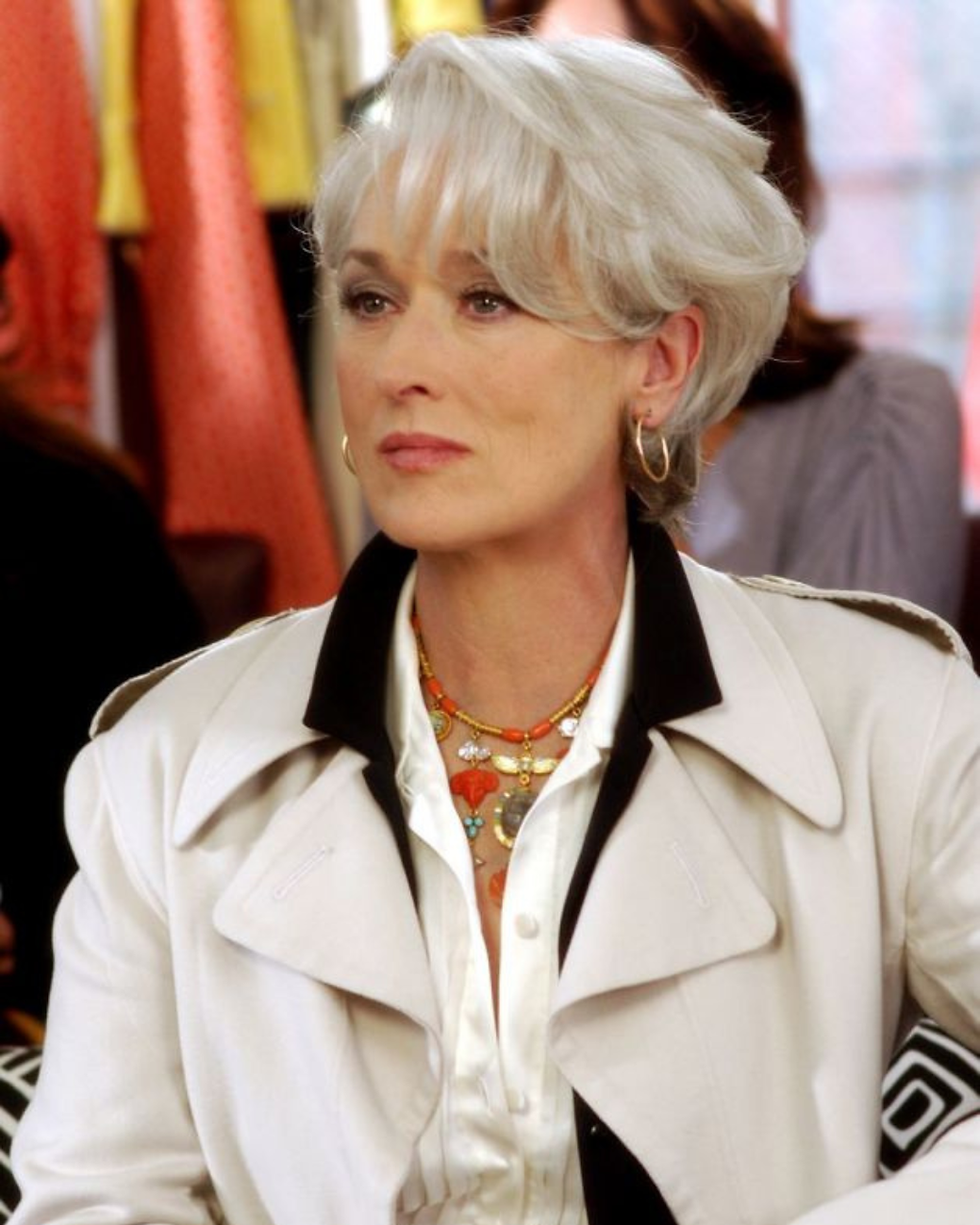
Miranda controls herself under pressure.
That is her survival strategy.
Control.
Composure.
Precision.
Emotional restraint.
Her nervous system says:
“If I remain composed, I remain powerful.”
And the truth is I think many leaders understand that feeling.
Particularly women in leadership.
Because women carrying power often feel enormous pressure to remain emotionally contained whilst simultaneously carrying extraordinary amounts of responsibility.
Miranda rarely falls apart publicly.
Not because she does not feel pressure.
But because she has trained herself not to reveal it.
That distinction matters.
There’s a scene in the first film where Miranda’s marriage is quietly falling apart behind the scenes, yet she still walks into work polished, composed, immaculate, and fully functioning.
That scene hits differently as you get older.
Because you begin to realise how many powerful people are carrying heartbreak, exhaustion, pressure, grief, stress, loneliness, or uncertainty privately whilst still having to lead publicly.
That level of emotional compartmentalisation can look powerful externally.
But internally?
It can become incredibly lonely.

And I think loneliness is one of the deepest themes underneath Miranda’s character.
Not because she lacks people around her.
But because vision itself can become isolating.
The higher people rise, the fewer spaces they often have where they can simply exhale.
Where they do not have to lead.
Perform.
Decide.
Carry.
Manage.
Hold everything together.
And I think that’s one of the hidden costs of leadership that people do not talk about enough.
The emotional weight of constantly being
“the strong one.”
Miranda carries that weight beautifully.
But she still carries it.
That is why I think her character resonates so deeply with ambitious women, founders, executives, creatives, and leaders.
Because many high-performing women know what it feels like to become so identified with excellence that vulnerability begins to feel dangerous.
To become so accustomed to carrying pressure that softness feels unfamiliar.
To become so relied upon that rest feels almost irresponsible.
And trust me, I understand that woman deeply too.
Not because I am Miranda Priestly, lol.
But because I understand what it feels like to carry vision, responsibility, pressure, standards, and ambition simultaneously.
I understand the emotional weight that can come with building something meaningful.
And I also understand how easy it can become to disconnect from yourself underneath all the performance, leadership, and responsibility.
That is one of the reasons I care so deeply about creating spaces where people — particularly leaders, founders, and high-performing individuals can reconnect with themselves beyond their role.
Not just spaces to relax.
But spaces to breathe.
Move.
Reflect.
Regulate.
Release stress and tension from the body and mind.
Reconnect with clarity, creativity, joy, and humanity again above all the outside noise.
Because leadership without self-connection eventually becomes depletion.
And vision carried without support can become incredibly heavy.
I think one of the greatest misconceptions about ambitious people is that because they are capable, they do not need care.
But capable people need support too.
Visionary people need support too.
The people carrying teams, companies, ideas, movements, families, and enormous levels of responsibility also deserve spaces where they can soften enough to simply be human again.
Not impressive.
Not productive.
Not performing.
Human.
And perhaps that is the deepest lesson underneath Miranda’s story.
Not whether ambition is good or bad.
Not whether power changes people.
But whether greatness can exist sustainably without emotional selfabandonment.
Because eventually, every visionary has to ask themselves:
Who supports the person carrying the vision?
And who are they when the room finally becomes quiet?
Next in the series:

Maxine Anthony
Creative Director and Founder of UNIKA
A company that sits at the intersection of movement, mindfulness, and meaningful connection, creating experiences designed to help people feel more energised, present, connected, and human again.
UNIKA primarily works within the corporate space, delivering movement-led wellbeing workshops and dance & music entertainment experiences for conferences, galas, awards nights, team away days, learning and development sessions, onboarding programmes, brand activations, retreats, and wider corporate events.
Whether it’s helping a room recharge and reconnect through a wellbeing workshop, or shifting the atmosphere and energy through a high-impact entertainment experience, the intention is always the same:
To create experiences that people genuinely connect with and feel.
Because people remember how spaces made them feel long after the event is over.
To explore how UNIKA can support your organisation, team, event, or community through movement-led wellbeing workshops and high-impact entertainment experiences, feel free to get in touch below.
📱 +44 (0)7740 070782


Comments